
 ONDA
ONDAROBOTICS
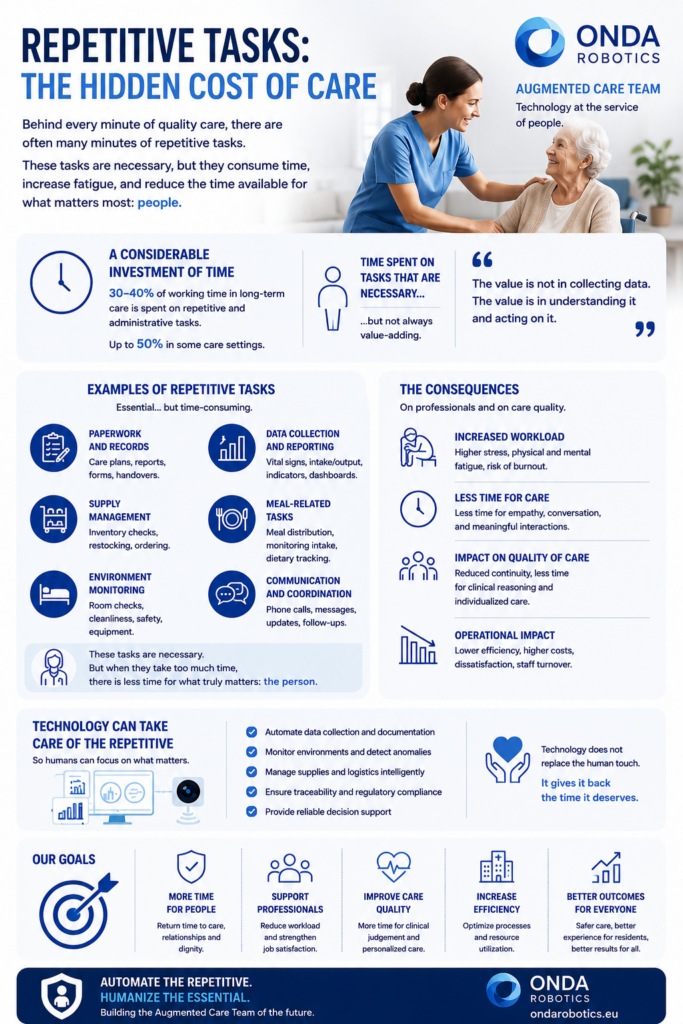
Repetitive Tasks in Long-Term Care: The Hidden Cost of Care
Repetitive Tasks in Long-Term Care: The Hidden Cost of Care
The problem nobody talks about
When people think about healthcare, they usually imagine diagnosis, treatment, and human relationships.
They think about physicians making decisions.
They think about nurses delivering care.
They think about conversations between professionals, patients, and families.
What they rarely see is the enormous amount of time spent on repetitive tasks.
Yet these activities occupy a significant part of daily work in hospitals, nursing homes, and long-term care facilities.
Documentation.
Data collection.
Reporting.
Checking.
Verifying.
Transcribing.
Communicating.
Repeating.
None of these tasks are inherently useless.
In fact, most of them are essential.
The problem is that they consume time, energy, and attention that could otherwise be dedicated to care.
Healthcare professionals are not expensive data-entry operators
Modern healthcare systems increasingly depend on information.
The challenge is that much of this information is still collected through manual processes.
A nurse measures a parameter.
The value is written down.
The value is entered into a software system.
The value is reviewed later.
The value is discussed again.
The same information may pass through several people before generating a decision.
The objective of healthcare professionals is not to collect data.
The objective is to understand what the data means.
A physician is not trained for ten years to copy information from one screen to another.
A nurse is not trained to spend hours every day documenting activities that have already occurred.
An aide is not trained to become a logistics coordinator.
Yet many professionals spend a considerable portion of their working day performing tasks that create little direct clinical value.
The hidden burden inside long-term care
Long-term care facilities provide a clear illustration of this challenge.
Consider a simple weight measurement.
A resident is accompanied to a scale.
The weight is recorded.
The value is entered into a software system.
The value is compared with previous measurements.
The information is reviewed by the care team.
The process is repeated again next month.
The purpose of the process is not the measurement itself.
The purpose is to identify risk.
The real clinical value lies in recognizing malnutrition, fluid retention, heart failure, or disease progression.
Everything else is merely a necessary pathway to obtain that information.
The same principle applies to hydration monitoring, falls prevention, medication management, nutrition programs, mobility assessment, and countless other daily activities.
The demographic challenge
The ageing of the population is creating a paradox.
Healthcare systems need more care than ever before.
At the same time, many countries face growing workforce shortages.
The question therefore becomes unavoidable:
How can professionals spend more time caring for people if increasing amounts of time are spent managing information?
The answer is unlikely to come from simply asking professionals to work harder.
The answer may come from changing how information is collected, processed, and delivered.
Automation is not about replacing people
The word “automation” often creates concern.
Many people immediately associate it with workforce reduction or replacement.
In healthcare, this is the wrong way to think about technology.
The objective is not to replace professionals.
The objective is to eliminate repetitive tasks that do not require human judgement.
Machines excel at repetition.
Humans excel at interpretation.
Machines excel at consistency.
Humans excel at empathy.
Machines excel at continuous monitoring.
Humans excel at understanding context.
The future of healthcare will depend on combining these strengths.
The emergence of the Augmented Care Team
At Onda Robotics, we believe that technology should become a member of the care ecosystem.
Not a replacement for professionals.
Not a substitute for relationships.
A support system.
An extension of the care team.
An Augmented Care Team.
In this model, technology could:
- collect information automatically;
- identify meaningful patterns;
- detect anomalies;
- transmit relevant alerts;
- support traceability;
- reduce administrative burden.
Meanwhile, healthcare professionals remain responsible for:
- clinical interpretation;
- ethical decisions;
- human interaction;
- care planning;
- communication with families.
Technology gathers information.
Humans provide meaning.
Returning time to care
Perhaps the most valuable outcome of automation is not efficiency.
It is time.
Every minute spent on unnecessary administrative repetition is a minute unavailable for care.
A conversation with a resident.
A discussion with a family member.
A clinical assessment.
A moment of reassurance.
A moment of dignity.
Technology cannot replace these moments.
But it can help create them.
By reducing repetitive work, healthcare systems can reinvest time where it creates the greatest value.
In people.
A vision for the future
The future of healthcare is not a choice between humans and machines.
It is a partnership.
A partnership in which technology performs repetitive tasks while professionals focus on what only humans can do.
Care.
Empathy.
Judgement.
Relationships.
This is the vision behind the Augmented Care Team.
Automate the repetitive.
Humanize the essential.