
 ONDA
ONDAROBOTICS
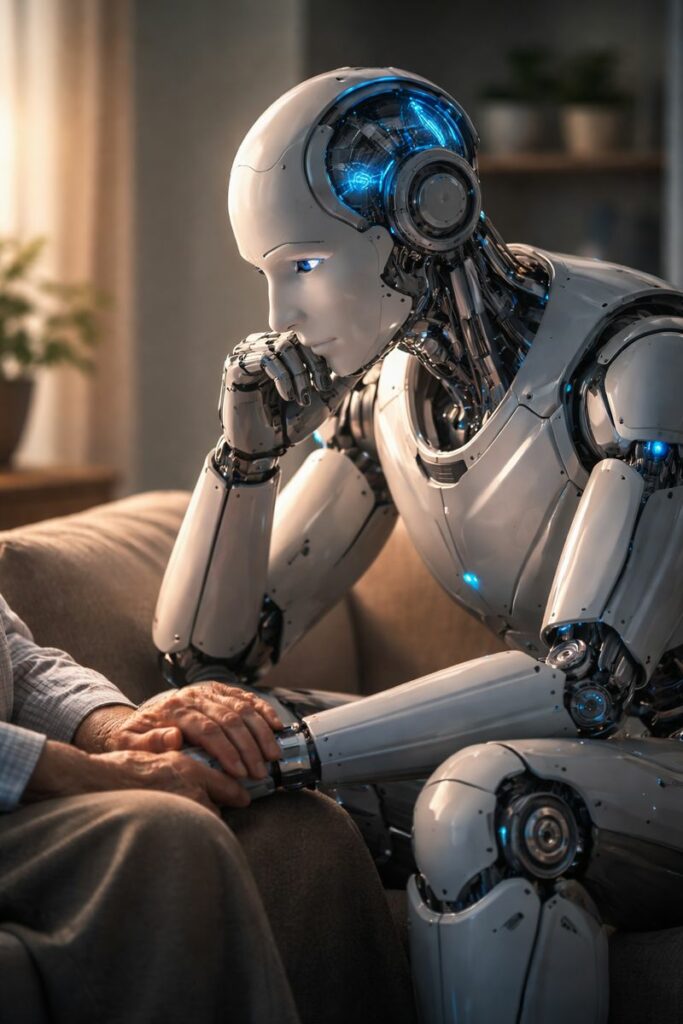
Aesthetics of Robots
The Aesthetics of Robots in Long-Term Care: A Clinical Perspective, Not Just an Engineering One
When it comes to the aesthetic acceptance of robots in healthcare, the technical literature almost automatically cites Masahiro Mori’s “uncanny valley”: beyond a certain threshold of resemblance to humans, a robot would stop being appealing and start being unsettling. It’s a compelling idea, often repeated as though it were an established clinical fact. It is not. It is the intuition of a Japanese roboticist from the 1970s, never validated on frail populations, never specifically tested on patients with cognitive decline, and shaped within a very particular cultural framework — Shinto Japan, with its own distinctive history of representing technology — that does not automatically transfer to the European context, let alone to geriatric care.
As a geriatrician working every day in long-term care facilities, my direct observation points in a different direction: an android with a more markedly human design does not frighten most of our elderly patients — it can actually facilitate acceptance, adherence, and even the caregiving relationship itself, particularly among Baby Boomer cohorts and older, and especially in patients with cognitive fragility.
A Starting Bias: Who Formulated the Theory, and For Whom
Mori was an engineer, not a clinician. His theory arose from a subjective observation about the average emotional reaction to visual stimuli — not from a study on frail patients, nor from observation in a care setting. It was later generalized to every context of use, including healthcare, without anyone asking whether an 85-year-old with moderate cognitive decline reacts the way a twenty-year-old in Japan reacts to a robot on a technology showroom floor. These are radically different populations, cultures, and needs.
There is also a second, less discussed but equally relevant element: the Japan that produced both Mori and much of contemporary robotic imagery is a society with a peculiar relationship to technology — often portrayed, in pop culture and manga alike, as something that ultimately overpowers its own creator — and with a social structure in which authority, gender, and hierarchy carry very specific characteristics. This is not the cultural framework of France or Italy, where the public tends to judge a care device on its clinical and relational substance rather than on an aesthetic borrowed from a narrative imagination that isn’t ours.
What I Observe on the Ward
Three direct clinical observations, recurring in everyday practice in long-term care, call into question the idea that a humanoid design is inherently risky for the frail patient.
Television as a threshold, not a threat. Many patients with dementia actively talk to the people they see on television. It is not uncommon that, when a figure symbolically “steps out” of the screen — a guest, an event, a scene that engages them emotionally — the patient gets up and tries to interact, sometimes seeking physical contact. This behavior, far from pathological in its internal logic, shows that human figures represented — even in a completely artificial, two-dimensional, screen-mediated way — are welcomed as legitimate interlocutors, not rejected as unsettling. A three-dimensional android, capable of responding and moving through real space, arguably occupies a position of greater, not lesser, relational plausibility compared to a figure on a screen.
Agnosia is not an argument against the humanoid — it is the clinical starting point. Agnosia — the difficulty in recognizing faces, objects, or situations for what they are — is a hallmark sign of dementia, present regardless of whether a robot is present in the environment or not. A patient with severe agnosia already misidentifies real people — family members, caregivers; introducing an android does not create a risk of identity confusion that did not exist before, it simply enters a perceptual framework already altered by the disease. The clinical question is not “does the robot look too human?” but rather: how do we design an interaction that remains understandable, predictable, and reassuring — even for someone whose perception of reality is already compromised — regardless of the device’s appearance.
Modesty, not unease, is the variable that determines acceptance in dependent patients. For the elderly patient who is not demented but dependent for basic daily activities — hygiene, mobility, personal care — the real relational obstacle is not the human likeness of the device, but the exposure of one’s own fragility to another human being. As I argued in my work published in Research Connections on generational identity and medical decision-making, many patients — particularly men from the Silent Generation and Baby Boomer cohorts — more readily accept assistance when it does not publicly expose their dependence to perceived social judgment. In this sense, relying on a machine with a human appearance, but which is not an actual human being, can reduce the burden of shame associated with very intimate care tasks: the machine does not judge, does not gossip, does not activate the same web of social meaning that another person’s presence does. A design that is too mechanical, too cold, too “appliance-like,” risks paradoxically being more depersonalizing — and therefore harder to accept in these contexts — than an android capable of conveying a minimal, recognizable relational presence.
The Problem Is Real, But Elsewhere: The “Frankenstein Complex” in Family Members
There is a real risk associated with an overly human design, but it needs to be correctly located: it concerns family members above all, not patients.
What It Is, In Plain Terms
The precise term is the “Frankenstein complex,” an expression coined by the writer Isaac Asimov, who used it throughout his robot stories to describe a very specific, very human fear: that an artificial creation, once it becomes intelligent enough or similar enough to us, will eventually turn against its creator. It isn’t fear of the “monster” itself — that’s only the surface — but a deeper fear of losing control over something made in our own image. Asimov regarded it as an irrational prejudice, to the point of inventing the famous Three Laws of Robotics as a narrative antidote: a way of imagining robots structurally incapable of causing harm, and of showing that the fear could, in the end, be unfounded.
Applied to our field, the Frankenstein complex describes a reaction we often observe — but almost never in the patient. It’s the son or daughter who struggles to watch an android care for their parent in gestures that “should” remain human. It’s the spouse who, observing from the outside with full lucidity, feels a discomfort the patient — perhaps already dealing with an illness that offers other ways of interpreting reality — simply does not feel. The patient, often, simply experiences the interaction for what it is: practical help, calm, non-threatening. It is the person watching from outside, fully aware, who projects onto the robot the fear that something too similar to us might one day replace us or slip out of our control.
This discomfort deserves to be taken seriously — in communication with families, in staff training, in transparency about what the device is and is not — but it should not become the criterion by which the robot is designed for the patient. You don’t design a colder machine to reassure the observer if doing so makes it less effective for the person who actually needs to use it.
A Resistance We Will See Everywhere, Not Just in Care Homes
It’s worth being clear on one point: this wariness will not remain confined to geriatrics. It’s reasonable to expect it to accompany the introduction of robots into every area of Western life — work, education, services, the home — because any technology that begins to occupy a historically human role goes through a phase of wariness before being accepted as normal. This has already happened, in different forms, with household electricity, with the first automated assembly lines, with artificial intelligence in everyday decisions. Each time, the initial resistance stemmed less from an actual technical problem than from discomfort at seeing a boundary once thought stable — who works, who decides, who cares for whom — begin to shift.
With assistive robots, we will likely see three types of resistance, worth distinguishing:
- Generational resistance, stronger among adults raised on an entirely human model of care, weaker among those already used to talking daily to a voice assistant or a smart interface;
- Professional resistance, tied to the fear — understandable but often unfounded — that the robot will be read as a replacement for staff rather than a support for them; this is addressed through transparency about its actual role, not through a less capable design;
- Symbolic resistance, the one closest to Asimov’s complex: discomfort with a machine that touches, accompanies, watches over — gestures our culture has always considered intrinsically human, regardless of who actually performs them.
This initial wariness, understandable as it is, has never historically been a good reason to forgo a useful technology — it wasn’t for anesthesia, nor for dialysis. It is, instead, something to be managed with as much care as goes into the design itself: honest communication, time, and the involvement of both those who will use the robot and those who will observe it. It is not an argument for building more distant machines; it is an argument for introducing them with the same care with which they are designed.
Toward a “Just Human Enough” Design
None of this means that any degree of anthropomorphism works indiscriminately. It means that the threshold of acceptability needs to be recalibrated on real clinical grounds — age, generation, cognitive status, the culture of the reference country — rather than on a model borrowed from an industrial and cultural context far removed from European geriatric care. An android designed for French or Italian long-term care facilities can afford more markedly human traits than the popular reading of the uncanny valley would suggest, provided that:
- behavior remains predictable and consistent, avoiding the ambiguity that actually generates disorientation (it is not appearance itself, but the inconsistency between appearance and behavior, that causes confusion);
- communication about the device’s role and limits stays clear at all times toward staff and families, to prevent undue projections;
- the design preserves the dignity of the older adult, avoiding both depersonalizing coldness and “cute” infantilization at all costs.
A Matter of Substance, Not Imported Aesthetics
European audiences — French and Italian in particular — tend to judge a care device by what it does and how it behaves, rather than by its distance from an aesthetic canon borrowed from a narrative imagination that isn’t theirs. It is on this clinical and relational substance — not on an imported fear never actually demonstrated on frail populations — that the design of assistive systems for dependent older adults should be built, starting, at ONDA Robotics, with how we think about the interaction between A.N.D.R.E.A. and the people it will accompany every day.
Article by ONDA Robotics.